
Insights / Stories
E-Commerce Uplifts Rural China: Insights from Zhijiang’s Digital Transformation
Overview of Zhijiang City
Geographical Location and Significance
Situated in the west of Hubei province, People's Republic of China, Zhijiang is a county-level city within Yichang City. Until the 1990s, it functioned as a county. Positioned on the northern shore of the Yangtze River, downstream from Yichang's central city, it serves as a critical hub in the open development of the Yangtze River Economic Belt. The city's economy has evolved impressively, ranking as one of the advanced counties and cities. It holds the 76th spot among the top 100 counties and cities nationwide, taking the lead in the province.
Economic Base and Development
Zhijiang's economic prosperity can be traced back to the strong industrial and agricultural base of the province. The city has successfully established four pillar industries, namely high-end food manufacturing, new chemical materials, medical supplies, high-end textiles, and advanced equipment manufacturing. As a significant agricultural city, Zhijiang's primary agricultural products include rice, rapeseed, live pigs, citrus, and cotton.
In a recent round (2018-2020), Zhijiang was honored as the nominated city of the national civilized city, and the "Civilized City of Hubei Province". Dongshi Town and Caodian Village received awards for provincial-level civilized towns and villages. The Guanmiao Mountain Village has been recognized as the “2017 China Beautiful Leisure Village” and National Civilized Village.
Historical and Cultural Significance
Zhijiang's rich history positions it as a renowned historical and cultural city in the province. Formerly known as Danyang, the city's Chu culture has deep roots. Zhijiang is identified as one of the birthplaces of Chengbeixi culture and Daxi culture. The Guanmiaoshan site, a representation of the Neolithic culture, is enlisted as a national key cultural relics protection unit. The city, dubbed the "hometown of Chinese folk culture and art," boasts national and provincial intangible cultural heritages such as Zhijiang Folk Blowing Music and Zhijiang Nanguan. Additionally, Zhijiang, known as a “Chinese famous liquor city,” celebrates the long-standing wine culture represented by the Qiantaiji Distillery. The “Zhijiang” wine enjoys national recognition.
In promoting national fitness and low-carbon travel, Zhijiang has developed bicycle lanes. It has become the first shared bicycle demonstration county in the country, and the 37th Mobike bicycle city in the world. Cycling has emerged as a popular means of transportation for its citizens.
Rural E-commerce Landscape in Zhijiang
Strategic Location Favoring Ecommerce
Zhijiang's strategic location makes it a transportation hub and an e-commerce city in the province. The Zhijiang River serves as a crucial node of the national regional transportation network. The Yangtze River Golden Waterway, with a natural deep-water coastline of 111.5 kilometers, bisects the city. It has 25 docks and 39 berths, with an annual cargo handling capacity of 11.46 million tons.
High Rate of E-commerce Adoption
E-commerce entrepreneurship in Zhijiang leads the nation. As per the public e-commerce entrepreneurship rankings released by the Alibaba Research Institute, Zhijiang holds the second position in the central and western region counties. It also ranked second nationwide in e-commerce men’s shoes sales.
The Pinghu Village of Dongxi Town was the first in Yichang to become a Taobao Village and the second in the province. Presently, four out of the nine Taobao villages in Hubei Province are situated in Zhijiang. Leveraging its favorable transportation location, industrial base, and e-commerce ecology, Zhijiang is quickly transforming into China's men's shoes e-commerce capital, the Three Gorges Eco-Economic Cooperation Zone e-commerce center, and express logistics distribution center.
Development of E-commerce Industrial Park
The towering skyscraper of the Zhijiang E-Commerce Industrial Park is a prominent landmark in the city. The park, which has become the city's e-commerce powerhouse, integrates functions of public service, marketing, product display, logistics and distribution, innovation and entrepreneurship, and financing support across e-commerce industry chains. It can house 100 appliance companies and entrepreneurs. The Zhejiang e-commerce operation model, introduced through specialized "operating service providers," builds a "platform + company + intelligent logistics + base + farmers" structure. By comprehensively integrating online and offline, it connects Zhijiang products directly to the market. This e-commerce industrial park propels the city's economic transformation and development, thereby driving the city's rapid economic growth.


The park encompasses various service centers and facilities, including:
- Agricultural Product Quality and Safety Traceability Center
- The “Golden and Tasteful” Brand Construction Center
- The Village Taozhijiang Service Center
- The E-commerce Promotion Center
- The Maisheng Zhongchuang Space
- Agricultural Products Exhibition Center
- Livestream Broadcast Room
- Brainstorming Room
The park offers services to approximately 11,000 companies and 7,800 online stores across China's four major e-commerce platforms. These e-commerce companies and online stores employ around 20,000 people and dispatch roughly 460,000 packages daily.
The park provides business incubation services to companies of a certain size. For the first three years, it does not charge any rent for office space. Additionally, it has established a dedicated e-commerce training center for all citizens and villagers, where it regularly organizes e-commerce training courses.
E-commerce Promotion Model in Zhijiang
During our field trip, we visited four Taobao villages in three towns:
- Longquantang village in Wen’an County
- Fairy Village in Fairy Town
- Pinghu Village and Yaojiangang Village in Dongxi Town
We also toured some upcoming Taobao villages, such as Dongqiao Village in Wen'an Town and Wutongmiao Village in Fairy Town. While exploring the countryside, town officials guided us through various e-commerce companies that sell agricultural and industrial products. We had the opportunity to visit an e-commerce company run by female entrepreneurs specializing in traditional Chinese dresses.
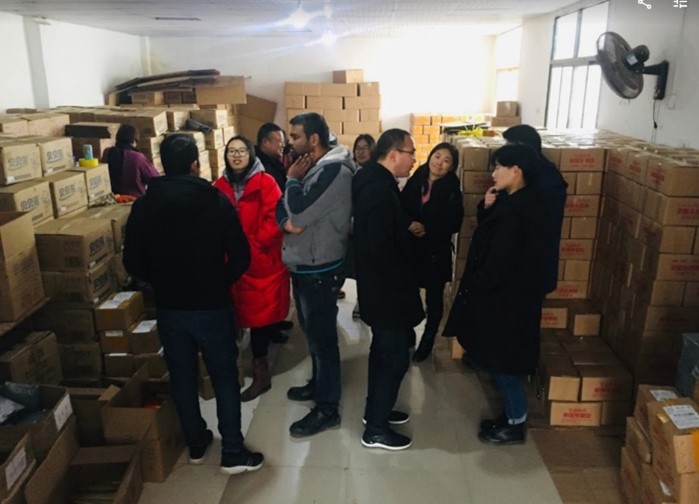
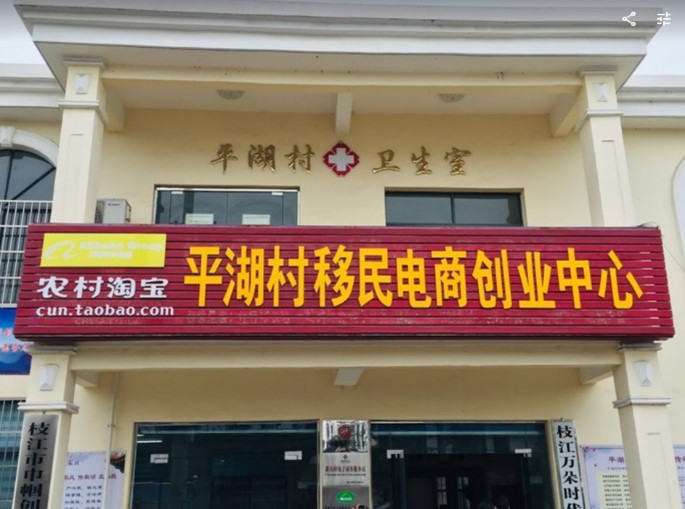
We noticed some shared attributes across Taobao villages in Zhijiang. These include:
- Each village has a comprehensive e-commerce service center which serves as a training and brainstorming center, product display center, business incubator, warehouse, packaging, and logistics center.
- E-commerce is promoted by inviting established e-commerce companies from other regions. The invited company must meet specific criteria based on experience and brand value.
- E-commerce companies support villagers in three ways: (1) free e-commerce training; (2) opportunities to sell products as commission agents in the company's online store; (3) job opportunities in packaging, logistics, and more.
Case Studies of Sample Villages
In Pinghu Village in Dangxi Town, government support has been crucial in advancing e-commerce. The village comprises individuals displaced by the Three Gorges Dam, with no history of farming. Moreover, the villagers did not engage in agriculture. Consequently, the government is striving to alleviate poverty through rural e-commerce.
To motivate people to embrace e-commerce, the government provides economic incentives to villagers. Those engaging in e-commerce can receive 15-20 yuan daily. Additionally, for each package dispatched via Taobao, they receive 5 yuan.
The same model applies to Longquantang, another village near Zhijiang City. Here, the government invited an e-commerce company to encourage villagers to join e-commerce. The company offers diverse support to villagers, including product development, training, and branding. They employ villagers as marketing agents to sell their products. The villagers earn commissions for each product they sell through e-commerce.
The products traded in Pinghu and Longquantang differ. Pinghu primarily deals in body heating stickers, while Longquantang mainly trades in agricultural products. However, these two villages share a common trait: their lack of experience and initial reluctance to join e-commerce.
Role of Public-Private Partnerships
E-commerce is promoted through the Public-Private Partnership (PPP) model. The government offers significant support to e-commerce companies willing to establish in the village. This support includes free office and storage space, tax subsidies, and access to affordable labor in rural areas.
To encourage villagers to engage in e-commerce, the government provides economic incentives such as a daily fixed amount support and a fixed amount for each item sold on the e-commerce platform.
Key Takeaways and Learning for Developing Countries
Importance of Government Support
The Zhijiang model demonstrates the vital role of government in facilitating rural e-commerce adoption. Across the developing world, governments are making strategic investments in digital infrastructure like rural broadband connectivity and power supply. They are also launching skill development programs to enable rural entrepreneurs to leverage e-commerce.
Public-private partnerships can provide localized support addressing awareness, training, access to finance and customized technological solutions. E-commerce platforms are empowering rural women entrepreneurs through targeted initiatives. With the backbone of infrastructure and digital literacy coupled with private sector outreach, developing countries can drive rapid e-commerce adoption in rural areas.
While the optimal model will depend on the village context, government support and public-private coordination are key to replicating the success of China's Taobao Villages. Strategic policies and investments can unlock the inclusive development potential of rural e-commerce globally.
Monopoly Advantage Not Required for Rural E-Commerce Success
Conventional thinking suggests that a village requires a unique monopoly advantage or specialized product ecosystem to successfully adopt the Taobao model and excel in e-commerce. However, findings from Pinghu and Longquantang challenge this notion.
These villages had no specific product history or advantage in any particular domain. Yet with the right external support through government incentives, private sector partnerships, infrastructure and training, they managed to develop flourishing rural e-commerce models.
The evidence indicates that monopoly advantage is not a prerequisite for becoming a thriving Taobao Village. The key success factors are an enabling business environment created through strategic policies, public-private collaboration, logistics access and skill development.
With dedicated efforts towards building awareness, capabilities, logistics and access to finance, even villages without any unique product ecosystem can reap transformational economic gains from integrating into the digital commerce landscape.
Rather than product specialization, the emphasis must be on strengthening holistic rural e-commerce readiness. This highlights the feasibility of replicating the Zhijiang model across diverse village settings in developing countries to drive broad-based rural development.
Job Creation and Economic Impact
Moreover, the PPP model can stimulate job creation and local economic development. Through training and education initiatives, villagers can acquire digital skills necessary for e-commerce, leading to the creation of new job roles such as digital marketers, online customer service representatives, and logistics coordinators. This diversification of job opportunities can be instrumental in reducing unemployment and underemployment in these regions.
In the short term, this model can accelerate rural economic development by connecting isolated rural communities with national and global markets. In the long run, it holds the promise of transforming these rural communities into vibrant economic hubs, thereby reducing rural-urban economic disparities and contributing to balanced regional development.
Replicability for Other Developing Regions
The Zhijiang model demonstrates immense potential for replication across developing regions grappling with rural poverty and limited economic opportunities.
In Africa, where smallholder farmers struggle with restricted market access, rural e-commerce can provide crucial linkages to urban centers and export channels. By enabling farmers to directly access customers, e-commerce can boost incomes, encourage agricultural growth, and nurture rural entrepreneurship. Similarly, by connecting rural artisans to expanded product design, financing and distribution networks, e-commerce can aid in preserving cultural heritage while promoting inclusive growth.
The PPP approach can facilitate context-specific solutions tailored to local needs, leveraging private sector expertise to build digital skills, provide mentoring, and strengthen market connections. Government initiatives must involve infrastructure development, incentives for adoption, and partnerships to provide digital literacy and e-commerce training customized for rural citizen-entrepreneurs.
In essence, the digital empowerment of rural communities can transform subsistence-based villages into thriving economic clusters integrated with the modern economy. The Taobao model offers a framework for participatory rural commerce that foregrounds public-private collaboration, human capability building, and entrepreneurial mindset change for enabling shared prosperity.
Conclusions
This analysis of rural e-commerce in Zhijiang offers valuable insights into the potential of e-commerce to stimulate economic growth in rural areas, both within China and globally. The Public-Private Partnership model implemented in Zhijiang demonstrates that with the right support and incentives, villagers can leverage e-commerce to improve incomes and living standards.
Several key takeaways emerge from Zhijiang's experience with rural e-commerce:
- Government support is essential in providing the basic infrastructure and services needed to facilitate e-commerce adoption. This includes investments in roads, internet connectivity, electricity, logistics networks, and digital skills training.
- The specific e-commerce model suited for a village depends on its unique characteristics such as demographics, skills, infrastructure, and products/resources. A one-size-fits-all approach may not work.
- While a monopoly advantage can boost e-commerce success, villages without such an advantage can also thrive through the PPP model which provides knowledge, experience and market access.
- E-commerce diversifies income sources for villagers and creates new job opportunities in areas like marketing, customer service, packaging and logistics. This stimulates broader local economic development.
- Rural e-commerce holds immense potential for developing regions with large agrarian populations and untapped resources. It can provide market linkages to enable small-scale producers to earn higher incomes.
Rural e-commerce powered by strategic government support and public-private collaboration is a promising pathway for inclusive development. As Zhijiang's experience shows, e-commerce can be an engine of rural growth and poverty alleviation globally if implemented thoughtfully based on local contexts. Further research on adaptable e-commerce models can help more villages join the digital economy.