
I recently accompanied an expert team from China on an advisory visit to Nelna Group’s mango farm in Sri Lanka. Our objective was to assess their farming operations and provide recommendations for improving mango quality, yields, and production practices.
In this report, I will summarize our findings and suggestions on topics spanning disease and pest control, vegetative growth management, blossoming induction, post-harvest processing, and more. Whether you are a commercial mango producer in Sri Lanka or simply interested in the technical aspects of mango cultivation, I believe you will find the insights from our experienced team informative.
Join me as I detail the opportunities and challenges we observed at Nelna Group’s orchard. By sharing the knowledge gathered first-hand by these specialists, it is my hope that we can collaborate to advance mango farming in Sri Lanka.
Overview
On request of Nelna company, our team took a long journey to pay a visit to Nelna Group Mango Farm on May 18 2023, and returned to Anuradhapura on the next day. We have following observations and preliminary conclusions as follows:
Disease and Pest Control
Diagnosis and Suggestions Before the Trip
Before we visited the farm, we got some pictures describing the disease and insects from the company staff who took part in the SSC project launching ceremony in Colombo on 11th of May. From these pictures, we consulted the insect and disease experts from China. They identified one insect and two diseases: Mango scale insect, Mango sooty mould and Mango anthracnose, which are independent (scale insect attack may induce the diseases) and which are easily developed under the shading and humid environment. The following preliminary comprehensive suggestions were given by experts from China and summarized by Luo Ruixiong. These were forwarded to Nelna before our visit:
On the branches: Mango scale insects
On the leaves and fruits: Mango Sooty Mould and Mango Anthracnose

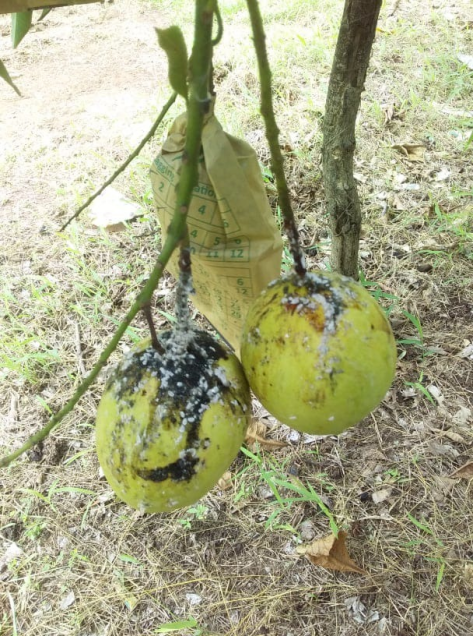

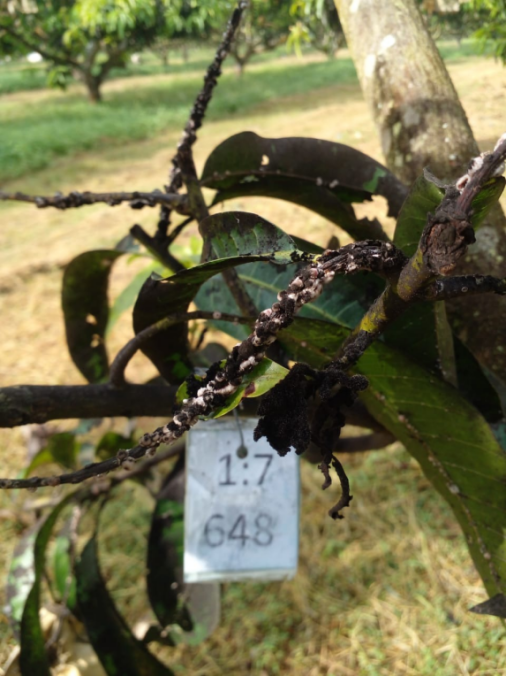
Mango Sooty Mould Prevention and Control Methods
(1) Timely prevention and control of pests, especially attention should be paid to scale insects. Adult scale insects have wax scale shells on their bodies and have strong resistance to pesticides. Therefore, the effect of pesticide application is only good when their scale shells have not yet formed during the nymph stage.
During the nymph stage of the scale beetle, 240 g/L spirotetramat suspension, Alpha-Cypermethrin, beta-cypermethrin, cyhalothrin, Chlorpyrifos, paraffin oil, etc. were used to spray the affected parts and plants. Scale shell insects often hide on the back of leaves, so attention should be paid when spraying pesticides.
(2) Maintain good plant pruning and orchard hygiene. During the florescence and fruiting stages, excessive weed growth should be controlled. After fruit harvest, the fruit tree should be pruned in a timely manner, including pruning dead branches and old leaves. The cut branches, leaves, and dead grass should be collected in piles and burned or buried deeply. For varieties with strong growth ability, appropriate pruning should be carried out. For older orchards, consideration should be given to retracting the tree crown in order to make the orchard as ventilated and transparent as possible.
(3) Avoid biased application of nitrogen fertilizer, and appropriately apply more organic fertilizer, phosphorus, and potassium fertilizers to enhance the tree’s ability to resist diseases and pests.
(4) Chemical control measures can be used, such as spraying 30% copper chloride oxide suspension(1.3 g/L) or 70% thiophanate-methyl wettable powder(0.75-1 g/L), or 1% lime half quantity Bordeaux liquid or lime sulfur. Generally, it should be sprayed at least once during the flowering and fruiting stages, and in orchards with severe disease, it is best to spray once every 1-2 months.
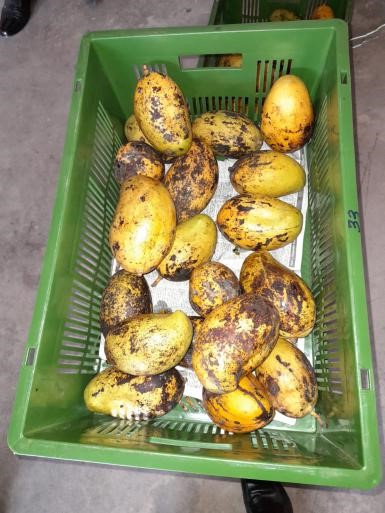
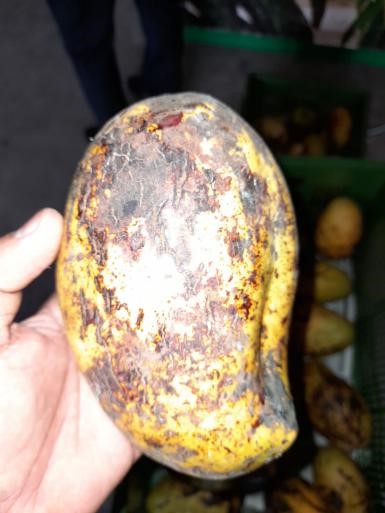
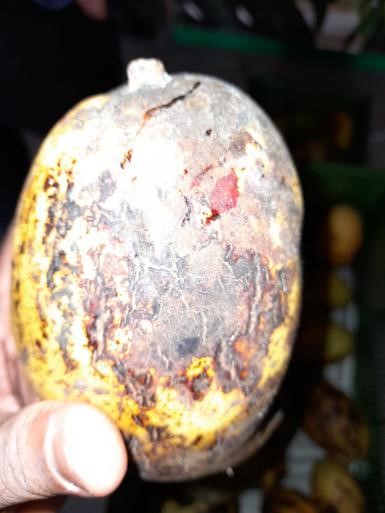
Mango Anthracnose Prevention and Control Methods
(1) Agricultural Prevention
Pay attention to combining chemical prevention and control before and after childbirth in order to achieve satisfactory prevention and control effects; Combining pruning, pruning diseased branches and leaves, removing diseased residues in the garden, and concentrating on burning or digging trenches to sprinkle lime for deep burial; Reasonably arrange planting density, combine pruning and shaping, cut off internal branches, and maintain ventilation and transparency in the orchard; Pay attention to drainage and reduce humidity in low-lying orchards; Young fruits should be bagged and protected in a timely manner after chemical control.
(2) Chemical Prevention and Control.
Focus on protecting tender leaves, flowers, and fruits. Spray once every 7-10 days after opening the leaves until they age. Spray once every 10 days after the bud is pulled out, continuously 3-4 times, and once a month during the small fruit stage until it matures. The reagents available for selection include 25% Azoxystrobin suspension (1-1.5 g/L), or 75% DACOTECH wettable powder(1.5-2.5 g/L), or 1% lime equivalent Bordeaux liquid, or 50% Thiophanate(1.5 g/L), or 50% carbendazim(1.3 g/L) , or 65% mancozeb wettable powder (1.3-1.8 g/L), or 50% Benomyl wettable powder (1.0 g/L). In arid areas or during high temperatures in summer, the concentration of pesticides should be appropriately reduced and medication should be avoided at noon to avoid causing harm to tender leaves and fruit peels.
Mango Scab Prevention and Control Methods
(1) Agricultural prevention
Pay attention to combining chemical prevention and control before and after the birth in order to achieve satisfactory prevention and control effects; Combining pruning, pruning diseased branches and leaves, removing diseased residues in the garden, and concentrating on burning or digging trenches to sprinkle lime for deep burying; Reasonably arrange planting density, combine pruning and shaping, cut off internal branches, and maintain air ventilation and light penetration in the orchard; Pay attention to drainage and reduce humidity in low-lying orchards; Young fruits should be bagged and protected in a timely manner after chemical control.
(2) Chemical prevention and control
Before flowering, spray with Bordeaux solution can be used for prevention, and 65% mancozeb wettable powder (1-1.3 g/L) or 30% copper chloride oxide suspension(1.3 g/L) can be used for spray protection during flowering and fruiting periods; At the during developing shoots, 30% copper chloride oxide suspension(1.3 g/L) or Bordeaux liquid spray was used for protection. In the humid season, apply 1-2 times for each shoot and 2-3 times during the young fruit stage, with an interval of 10-15 days.
This document was clarified and refined when the expert team visited the farm.
Diagnosis and Suggestions After the Trip
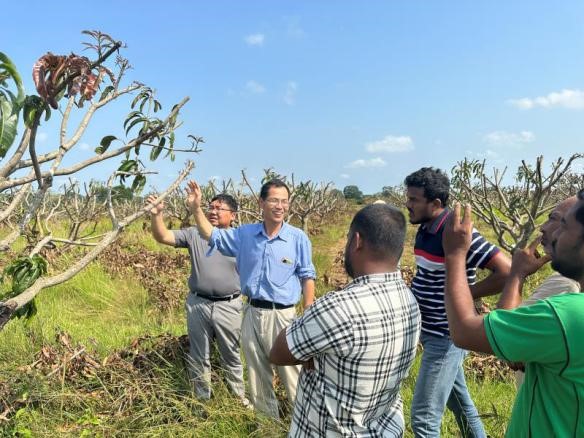
After we arrived at the farm at 14:00, the managers there arranged a field trip together with local technicians to see the disease symptoms on the trees, pruned mango trees and pruned branch management. We came to the following conclusions about the diseases and insects:
Reasons for Disease and Insect Issues
There is an ideal place for insect reproduction: There is a national park beside the mango farm (could be a temporary habitat), there is a lake catching the water from the national park (conducive for insect reproduction), there are nutritious mango trees providing sugar and nutrition for insects. Thus it is easy for insects to complete their life cycle in the farm or between farm and the park: eggs-larva-pupa-adult. The pruned tender branches left in the field provide shelters for previous generations of insects.
The mango bagging method may be incorrect. The loose bagging leaves gaps that allow ants and other insects to enter the bag and eat the mango. More importantly, the water (rain) may follow the calyx and flow into the bag, keeping high moisture in the bag, conducive for insects and disease development in the bag. This explains the high percentage of disease during the raining season.
There is an interdependence between insect attack and disease occurrence.
Suggestions
To control the insects, the key is to break down their life cycle in the farm:
First, break down the life cycle of mango scale insects between the national park and farm. Remove the grasses (by sheep grazing or chemical control) to widen the isolation belt between the mango farm and the national park. The wider the belt, the more difficult for insects to migrate between farm and the park. The sunshine will kill the diseases and insects while the high grass along the fence may provide shelter for insects.
Second, break the life cycle of mango scale insects within the mango farm. Collect the pruned branches to smash them into pieces and compose under plastic cover. High temperature from the sunshine and fermentation may kill the diseases and insects and return organic fertilizers. This could be done right in the field to reduce labor for transportation.
Third, use a tight bagging method. A tight bagging method was demonstrated and a proper bagging video was shown to the technicians (see attached file). We think training should be given in the future to all workers doing bagging.
Fourth, we suggest early prevention. Proper pruning to increase light penetration and chemical spraying methods suggested above are also recommended.


Vegetation Growth Control, Blossoming Inducement and Yield Improvement
When the second shoot of pruned branches comes out to reach about 10 cm long, we suggest applying Paclobutrazol in the soil near the tree (15% Paclobutrazol wettable powder 10~15g for every one meter of tree canopy diameter) according to the size of the tree.

After the leaves of the second shoot become green, start to control the growth of shoots. Using paclobutrazol + mepiquat chloride + potassium phosphate monobasic and others on the leaves to control the growth of shoots, generally spray one time every 7-10 days. The interval and frequency of spraying depend on the drug effect, and it is generally advisable to prevent new shoots from sprouting and sprouting during the shoot control period.
After finishing the operations above, then start to induce blossoming. Using ethrel + cytokinin + borax + compound sodium nitrophenolate and others on the leaves to induce blossoming.
After the emergence of inflorescence, spray insecticides to protect the inflorescence, and spray fertilizers on the surface of leaves.
The purpose of shoot growth control is to reduce the invalid vegetation growth (which later have been pruned as the waste branches) and lead the photosynthetic products to the fruits. Thus it is very important to remove the new shoots once trees start to produce fruits.
Post Harvest Processing Equipment Discussion and Management Suggestions
After the field trip, the visiting experts and local specialists had a short meeting to discuss the post harvest mango processing equipment requirement and mango bagging quality problems. The Nelna company introduced its requirements for post-harvest processing equipment and experts agreed to look for suppliers from China. And experts helped the company communicate with its Chinese mango bag exporter to solve the bag quality problem, discuss compensation and improvement measures.
Additional Management Practices and Innovations
Coming back from the farm, we shared some management practices and innovations in China. In China most mango farms are managed by owners or by managers with a base pay plus profit sharing options. We use internet video cameras for security control to save on labor costs. And farms are explored as agro-tourism or eco-tourism destinations, with the help of ecommerce. This not only provides extra income, but also helps build a positive image of the farm for product promotion. Nelna mango farm has a good basic environment. It may want to explore eco-tourism to attract international tourists. For this purpose, some internet infrastructure, living conditions, natural watching facilities and structures should be improved.

Banana Farm Visit
After the mango farm, we paid a short visit to its neighbor farm: Dole banana farm.
Dole farm is the only one farm that got the permission to export banana to the Chinese market since it has strict quarantine measures. But so far there is not even one kg of banana that has been exported to China. We wanted to understand the reasons. After a short discussion, we realized the banana exports to the Middle East currently face a shortage in supply. If fully satisfied, the supply quantity should be doubled.
On the way back to Anuradhapura, we visited a small banana farmer in Embilipitiya. The farmer’s bananas had some disease he had never seen before. The experts took pictures of the problematic plants and asked plant protection experts in China. It turned out to be Banana Mosaic Heart Rot Disease and Banana Bunchy Top Disease.
These two diseases are closely related to cultivation and weather conditions. Aphids are the major spreading carrier of the virus.
Control measures: (1) Choosing virus-free plants to grow; (2) Fertilizing on time and ensuring enough nutrition to increase the disease resistance of the banana; (3) Spray imidacloprid or Avermectin to prevent the plant from insect vectors such as aphids; (4) Once found, remove diseased plants. The newly grown ones might become normal.
Conclusion
Our visit to Nelna Group’s mango farm provided an excellent opportunity to evaluate their operations and provide targeted recommendations for improvement. By addressing issues like insect control, disease prevention, growth management, and post-harvest handling, we believe Nelna can significantly increase the quality and productivity of their orchard. With proper implementation of practices like sanitation, pruning, tight fruit bagging, and strategic chemical spraying, the farm should be able to mitigate crop losses and maximize yields.
We also discussed innovations in farm management that Nelna could consider, such as video monitoring, agro-tourism, and e-commerce. With additional investments in infrastructure and marketing, the farm has potential to further diversify revenue streams beyond just mango sales.
It was a privilege to share our expertise and learn together with Nelna’s team. We hope this collaborative report provides a roadmap to enhance mango farming success in Sri Lanka. By continually refining practices and exchanging knowledge, the country’s mango producers can thrive. We look forward to maintaining an open dialogue and supporting one another in future efforts.



 CBEC for Development
Leave a comment